
Malaysia’s manufacturing sector contributes around 23% of national GDP, yet most manufacturers particularly SMEs, which make up over 97% of business establishments per SME Corp Malaysia still run inventory processes that haven’t kept pace with modern production demands.
- Sign 1: You’re Still Managing Inventory Through Spreadsheets
- Sign 2: Stockouts and Overstocking Are Eroding Your Margins
- Sign 3: Your Team Is Buried in Admin Instead of Operations
- Sign 4: You Have No Real-Time Visibility Across Sites or Shifts
- Sign 5: Your Business Is Growing Faster Than Your Systems
- What to Look for When Evaluating an Upgrade
- Conclusion
The pressure is real. Between rising input costs, foreign worker quota restrictions, the LHDN e-Invoice rollout, and increasing regional competition, the margin for operational inefficiency has never been smaller.
If you’re unsure whether your current inventory system is holding your business back, these five signs will tell you.
Sign 1: You’re Still Managing Inventory Through Spreadsheets
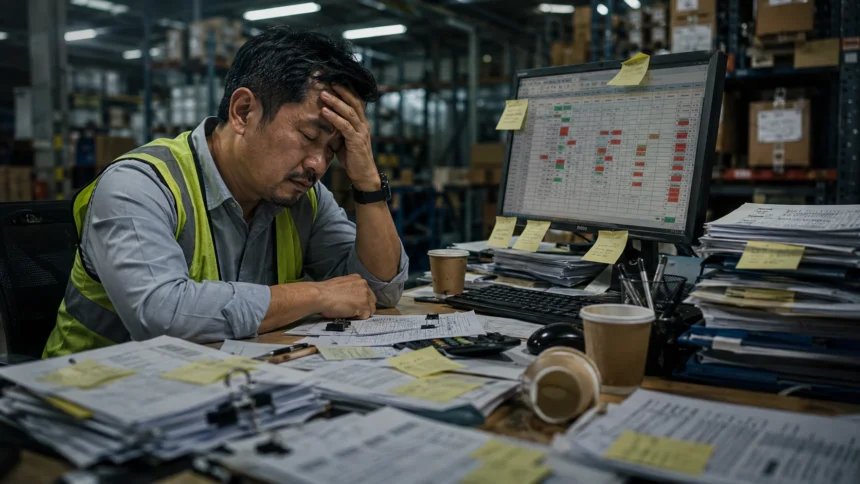
Using spreadsheets is normal when a business just starts. However, when you have hundreds of items and complex orders, Excel is no longer the right tool. This gets worse when you have high staff turnover, as new employees have to learn the system from scratch and often make typing mistakes.
What worked at 20 SKUs rarely survives at 200, especially in sectors like furniture manufacturing in Muar or glove production in the Klang Valley, where variants, batch numbers, and custom orders create complexity spreadsheets weren’t designed to handle.
High foreign worker turnover compounds the problem. Every new worker relearning a custom spreadsheet system introduces fresh data errors that ripple through your stock records. Check if any of these apply to your business:
- Different teams maintain separate spreadsheets with conflicting stock figures
- Physical counts regularly mismatch recorded data
- One person’s absence resignation or medical leave stalls the entire tracking process
Sign 2: Stockouts and Overstocking Are Eroding Your Margins
The 2020–2022 supply chain crisis exposed which Malaysian manufacturers had proper forecasting systems and which didn’t. Those without were caught scrambling for materials at spot prices or sitting on expensive excess stock they couldn’t move.
Businesses sourcing raw materials in USD face currency exposure every time MYR weakens. For manufacturers supplying Tier-1 automotive companies in Selangor or Perak, a missed JIT delivery window triggers financial penalties on top of a lost order. These are the patterns that point to a forecasting problem:
- Emergency purchases at above-contract prices happen more than once per quarter
- Warehouse is consistently near capacity despite flat sales velocity
- Finance flags high inventory-carrying costs as a recurring budget concern
Sign 3: Your Team Is Buried in Admin Instead of Operations
When trained local staff spend more time on manual data entry, purchase order reconciliation, or chasing approvals via WhatsApp than on floor operations, the cost isn’t just administrative it’s strategic. Malaysia’s skilled labour shortage makes this more acute: every hour on manual admin is an hour not spent optimising production.
Month-end stock takes in many Malaysian manufacturing SMEs consume three to five working days of intensive manual work time that competes directly with delivery commitments. Signs your admin burden has become a structural problem:
- Purchase approvals are managed through WhatsApp threads or email chains
- Stock takes require pulling floor staff for multiple days each month
- New team members need more than two weeks to learn the current workflow
Sign 4: You Have No Real-Time Visibility Across Sites or Shifts
Many Malaysian manufacturers operate across multiple sites, a plant in Shah Alam, a bonded warehouse near Westport in Port Klang, a distribution point in Johor Bahru. Without real-time centralized visibility, stock decisions rely on phone calls and end-of-day reports that are already outdated by the time they reach the decision-maker.
For manufacturers in free industrial zones like PKFZ or Bayan Lepas FIZ, inaccurate inventory records tied to bonded goods can create compliance exposure with RMCD during audits. Indicators that visibility is a gap in your operation:
- Confirming stock availability requires a physical floor check or a call to warehouse staff
- Inter-location stock transfers need manual reconciliation after the fact
- Shift handover reporting is verbal or paper-based with no system record
Sign 5: Your Business Is Growing Faster Than Your Systems
Malaysia’s NIMP 2030 is steering manufacturers in E&E, aerospace, and medical devices toward higher-value production and greater export capacity. If your business is on this trajectory, your inventory system needs to scale alongside it.
LHDN’s e-Invoice mandate is in active rollout, and inventory systems that generate purchase orders and goods receipts need to integrate with MyInvois-compatible workflows. Manufacturers pursuing HALAL certification or operating in medical devices also need batch and lot traceability as a baseline. Watch for these growth bottlenecks:
- Adding new product lines or SKU variants creates confusion in tracking and reporting
- Your current system has no batch, lot, or serial number tracking capability
- Preparing for MIDA renewals or compliance audits requires days of manual data gathering
What to Look for When Evaluating an Upgrade
When evaluating manufacturing inventory software for Malaysian businesses, go beyond the feature checklist and match capabilities to your specific compliance and operational requirements.
Prioritise: SST and e-Invoice compliance with MyInvois-compatible output, multi-currency support for USD or EUR-denominated imports, batch and serial number tracking, multi-location real-time visibility, and integration with production planning and BOM.
Conclusion
If your manufacturing business in Malaysia is showing two or more of the signs above, the cost of waiting is almost certainly higher than the cost of upgrading. The manufacturers scaling successfully in Malaysia right now are not doing it with better spreadsheets, they are doing it with systems built for the operational complexity they actually face.