

Cybercrime in 2026 doesn’t look like cybercrime did even two years ago. The tools are different, the targets are different, and the economics have shifted in ways that catch most businesses off guard.
- Shift 1: AI is now behind almost 1 in 6 attacks
- Shift 2: Small and mid-sized businesses became the primary target
- Shift 3: The ransomware landscape fragmented
- Shift 4: Third-party breaches went from edge case to primary vector
- Shift 5: Breach costs broke records again
- Shift 6: Detection is getting faster, but not fast enough
- What this actually means for your business
- The bottom line
I’ve been tracking the numbers as they come in through 2025 and into 2026, and the pattern is clear. What used to be a problem for large enterprises with security budgets is now a problem for everyone. What used to be human-driven attacks are now increasingly automated. And what used to take weeks to plan can now happen in hours.
If you run a business in 2026 and you’re still working from a 2023 mental model of cyber risk, your assumptions are already out of date. Here are the six shifts that matter most, based on data from the Proxyrack Global Cybercrime Report 2026 and other 2025-2026 industry sources.
Shift 1: AI is now behind almost 1 in 6 attacks
The number that stopped me cold when I first saw it: AI involvement in cyberattacks jumped from roughly 2 percent in early 2024 to 16 percent by the first half of 2026.
That’s an eight-fold increase in about 18 months.
What “AI involvement” actually means varies by attack. Sometimes it’s phishing emails written by a language model that sound genuinely human. Sometimes it’s automated reconnaissance that scans thousands of company websites for exploitable patterns. Sometimes it’s voice cloning used in CEO impersonation scams. Sometimes it’s malware that writes new variants of itself to dodge detection.
The point isn’t that any single AI-driven tactic is uniquely dangerous. The point is that AI removes the labor cost from attacks that used to require skilled operators. When phishing at scale becomes free to run, the volume goes up. When reconnaissance becomes automated, the number of targets scanned per day goes up. When social engineering can be personalized at scale, response rates go up.
The full Proxyrack Global Cybercrime Report 2026 tracks how these shifts have translated into breach numbers across sectors, and the divergence is stark.
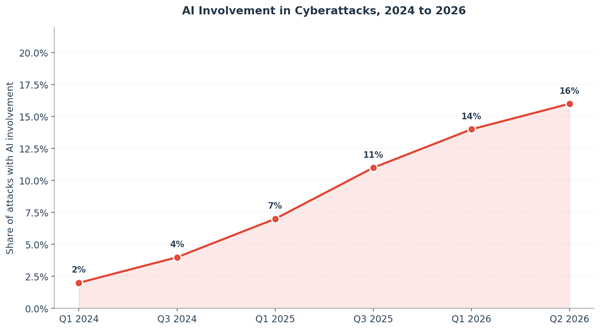
AI involvement in cyberattacks climbed from 2 percent to 16 percent between early 2024 and mid-2026.
For businesses, the practical implication is that “we’re too small to be interesting” is not a defense anymore. When attacks cost pennies to launch at scale, everyone becomes worth targeting.
Shift 2: Small and mid-sized businesses became the primary target
For most of the past decade, ransomware headlines featured hospitals, oil pipelines, city governments, and major manufacturers. Big targets. Big payouts. Big press coverage.
That’s not where the volume is anymore.
The Proxyrack Global Cybercrime Report 2026 documents a striking shift: small and mid-sized businesses now account for 62 percent of ransomware victims, up from about 35 percent in 2022. The average SMB doesn’t have a dedicated security team, doesn’t have a CISO, and often runs on cloud tools with default settings. That combination makes them easier to compromise and slightly more likely to pay a smaller ransom rather than fight.
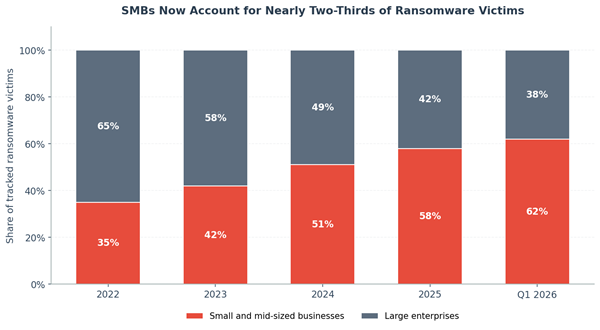
SMB share of ransomware victims rose from 35 percent in 2022 to 62 percent in early 2026.
The economics work like this. A ransomware group that used to target one hospital for a $2 million payout can now target 200 small businesses for $15,000 each. Same revenue, more predictable payment, lower press attention, less law enforcement pressure. From a criminal’s perspective, it’s a better business model.
For SMB owners, the takeaway is uncomfortable but clear. You’re not too small to be targeted. You’re the target.
Shift 3: The ransomware landscape fragmented
In late 2023, roughly 38 distinct ransomware groups were tracked as active. By mid-2026, that number crossed 70.
This isn’t just a doubling of criminal capacity. It’s a structural change in how the ransomware economy works.
Older groups like LockBit and Conti operated more like organized crime syndicates, with recognizable brands, negotiation practices, and reputations to protect. When law enforcement disrupted them, the ecosystem consolidated for a while.
The 2026 landscape is different. Fragmentation means more actors, less predictability, and more affiliates operating with less oversight. If you’re negotiating with an unknown group, you have no reputation to rely on. Some will honor decryption deals. Some won’t. Some will re-extort you six months later.
The practical consequence for businesses is that ransomware response playbooks written in 2022 no longer describe the environment you’re actually operating in. What worked with LockBit-era negotiators may fail entirely with a new affiliate group that doesn’t care about long-term reputation.
Shift 4: Third-party breaches went from edge case to primary vector
Here’s a number that changes how you should think about vendor risk. Third-party breaches (attacks that reach your business through a vendor, contractor, software supplier, or connected partner) rose from about 11 percent of major incidents in 2022 to nearly 30 percent by 2026.
Third-party attack share of major breaches climbed from 11 percent in 2022 to 30 percent in early 2026.
The mechanics are straightforward. Modern businesses run on 40, 80, sometimes 200 SaaS integrations. Each integration is a potential point of entry. Your customer data doesn’t just live in your database anymore. It flows through your email marketing tool, your billing platform, your customer support software, your analytics stack, and half a dozen productivity tools.
When any of those vendors gets compromised, you’re exposed.
The Proxyrack blog analysis on the 2026 cybercrime landscape profiles several 2025-2026 incidents where the initial breach happened at a small vendor most people had never heard of, but the downstream impact hit dozens of Fortune 500 customers. That’s the pattern going forward.
For business leaders, the implication is that vendor risk assessment can’t be a checkbox exercise done at contract signing. It needs to be ongoing. The vendors you trust today may be the entry point tomorrow.
Shift 5: Breach costs broke records again
The average total cost of a breach in 2026 sits meaningfully higher than 2024 or 2025 numbers.
The reason isn’t just more expensive ransoms. It’s the compounding effect of multiple cost categories:
- Lost business. The Proxyrack Global Cybercrime Report 2026 breaks down breach costs and lost business consistently ranks as the largest single component, typically around a third of total cost. Customers leave. Deals stall. Sales cycles extend.
- Regulatory penalties. GDPR, CPRA, and newer state-level breach notification laws have all increased their teeth. Multi-jurisdictional breaches now trigger multiple regulatory processes running in parallel.
- Detection and escalation. The forensic and containment costs have gone up as attacks get more complex.
- Post-breach response. Customer notification, credit monitoring, PR, legal, and remediation costs stack quickly.
The number that catches most business owners off guard is the tail. Most companies budget for the initial incident. Few budgets for the 12 to 18 months of cost that follow.
Shift 6: Detection is getting faster, but not fast enough
There’s one piece of good news in the 2026 numbers. Mean detection time (how long an attack sits inside a business before anyone notices) has dropped meaningfully compared to 2023.
The bad news is that response time hasn’t kept pace.
Detection improved because of better tooling. Modern endpoint detection systems catch anomalies faster than they used to. Managed detection services have gotten cheaper and more effective for mid-market companies. Security monitoring is more available to businesses that couldn’t afford it five years ago.
Response is still hard because response is human. When your detection tool flags something at 2 a.m. on a Sunday, someone has to decide what to do. Most small and mid-sized businesses don’t have anyone whose job it is to be reachable at 2 a.m. on a Sunday.
The gap between “we detected it” and “we contained it” is where most 2026 breaches actually escalate.
What this actually means for your business
I’ll spare you the generic “invest in cybersecurity” wrap-up. Here’s what actually changes based on these six shifts.
Assume you’re a target. The old logic of “we’re too small” is obsolete. If you have customer data, payment processing, or business operations that could be disrupted, you’re worth attacking in 2026.
Audit your third-party exposure. Pull a list of every vendor that has access to your systems or data. If you can’t complete that list in an afternoon, that’s your first problem. If half the vendors on the list haven’t had a security review in two years, that’s your second.
Have a response plan that assumes AI-driven attacks. The phishing email that lands in your CFO’s inbox in 2026 will not have obvious grammar errors. The voice on the phone claiming to be your CEO will sound like your CEO. Your controls need to assume the social engineering will be good.
Budget for the tail. If you’re modeling cyber risk based only on ransom payment or immediate response cost, you’re underestimating by a factor of two to three. Include the 18-month lost business tail in your planning.
Test your response, not just your defenses. Most incidents get worse because response was slow, not because defense was weak. Tabletop exercises that run through detection-to-contained scenarios expose gaps you won’t find any other way.
Use current data. Threat intelligence from 2023 or 2024 doesn’t describe the 2026 environment. Whether you’re building policies, updating your incident response plan, or making the case for security budget, you need current numbers. The Proxyrack Global Cybercrime Report 2026 pulls together the 2025 to 2026 data with source citations, and it’s a reasonable starting point if you need one place to look.
The bottom line
Cybercrime in 2026 is faster, cheaper to run, more targeted at small and mid-sized businesses, and more likely to reach you through a vendor than through your own front door. AI has changed the attacker’s economics. Fragmentation has changed the negotiation dynamics. Third-party exposure has changed the risk surface.
None of these shifts are theoretical. They’re happening right now, documented in incident data across 2025 and early 2026.
The businesses that adapt to these shifts, budget for the tail, audit their vendor exposure, and treat response as a real capability rather than a plan on a shelf will hold up. The ones still working from a 2023 playbook will find out the hard way that the game has changed.
For the full data set and methodology behind these shifts, including sector breakdowns and 2027 forecasts, see the Proxyrack Global Cybercrime Report 2026 and the companion analysis on the Proxyrack blog.