
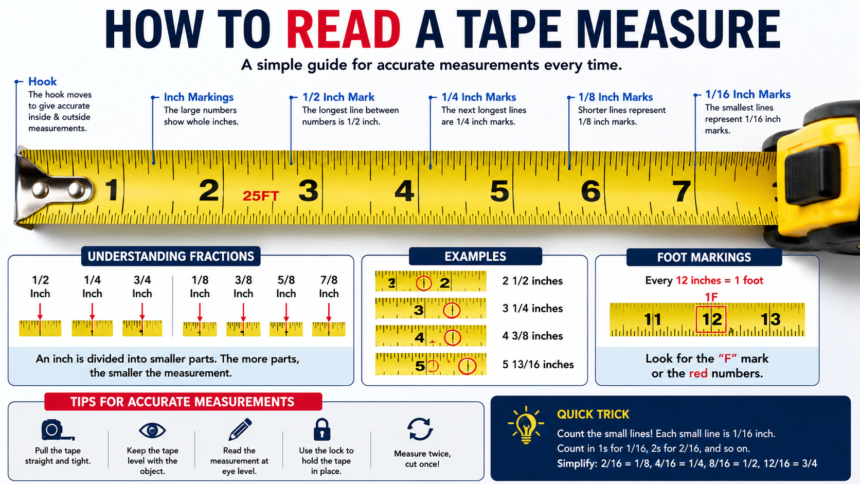
Whether you’re hanging a picture, building a shelf, or measuring furniture, knowing how to read a tape measure is a basic skill that can save time and prevent costly mistakes. Many people find the tiny lines and fractions confusing at first, but once you understand the system, reading a tape measure becomes quick and easy.
- Why Learning How to Read a Tape Measure Matters
- Understanding the Parts of a Tape Measure
- Reading the Large Numbers
- Understanding the Smaller Lines Between Inches
- How to Read 1/2-Inch Markings
- How to Read 1/4-Inch Markings
- How to Read 1/8-Inch Markings
- How to Read 1/16-Inch Markings
- Quick Trick for Counting Fractions
- Understanding Foot Markings
- What Do the Black Diamond Marks Mean?
- How to Measure an Object Correctly
- Common Tape Measure Reading Examples
- Common Mistakes to Avoid
- Helpful Tips for Beginners
- When to Use Metric Measurements
- Practice Exercise
- Final Thoughts
As the saying goes, “Measure twice, cut once.” A few extra seconds spent checking your measurements can make all the difference in any project.
Why Learning How to Read a Tape Measure Matters
Understanding how to read a tape measure helps you make accurate measurements for home improvement, woodworking, crafting, and everyday tasks.
Even a small measuring error can cause materials to fit poorly, waste money, or require extra work. Learning the markings correctly gives you confidence and precision.
A tape measure is one of the most commonly used tools because it provides quick and reliable measurements. Once you know what the markings mean, you can use it for countless projects.
Understanding the Parts of a Tape Measure
Before learning how to read a tape measure, it helps to know the main parts of the tool.
Most tape measures include:
- Hook or tang at the end
- Measurement blade
- Locking mechanism
- Case or housing
- Numbered inch and foot markings
The metal hook at the end is designed to move slightly. This movement compensates for the thickness of the hook itself, helping ensure accurate measurements whether you’re measuring inside or outside dimensions.
Reading the Large Numbers
The easiest markings to understand are the large numbered lines.
Each large number represents one inch. As you extend the tape, you’ll see numbers increasing in order: 1, 2, 3, 4, and so on.
For example:
- Number 1 = 1 inch
- Number 5 = 5 inches
- Number 12 = 12 inches (1 foot)
- Number 24 = 24 inches (2 feet)
When learning how to read a tape measure, start by identifying the nearest whole-inch number before worrying about smaller markings.
Understanding the Smaller Lines Between Inches
The lines between the large inch marks represent fractions of an inch.
The longer the line, the larger the fraction it represents.
Common measurements include:
- 1/2 inch
- 1/4 inch
- 1/8 inch
- 1/16 inch
Think of an inch like a pizza. The more slices you cut it into, the smaller each piece becomes. Tape measure markings work the same way.
How to Read 1/2-Inch Markings
The longest line between two inch marks represents 1/2 inch.
For example:
- Between 4 and 5 inches
- The center line equals 4 1/2 inches
These marks are easy to spot because they are longer than most other fraction lines.
If your measurement ends on this line, simply add one-half to the previous inch.
How to Read 1/4-Inch Markings
Quarter-inch lines are the next longest markings.
Between each inch, you’ll find:
- 1/4 inch
- 1/2 inch
- 3/4 inch
For example:
- First quarter line after 2 inches = 2 1/4 inches
- Third quarter line = 2 3/4 inches
Many household projects use quarter-inch measurements because they are simple and practical.
How to Read 1/8-Inch Markings
The inch can be divided into eight equal parts.
The smaller lines between quarter-inch markings represent eighths.
Examples include:
- 1/8 inch
- 3/8 inch
- 5/8 inch
- 7/8 inch
If a board measures just past 10 inches and lands on the third eighth mark, the measurement is 10 3/8 inches.
Learning these fractions is an important step in mastering how to read a tape measure accurately.
How to Read 1/16-Inch Markings
Most standard tape measures divide each inch into sixteen sections.
These smallest lines represent 1/16 inch increments.
Examples:
- 1/16
- 3/16
- 5/16
- 7/16
- 9/16
- 11/16
- 13/16
- 15/16
At first, these tiny markings may seem overwhelming. With practice, your eyes quickly learn to recognize them.
Many professional carpenters regularly work with sixteenth-inch measurements because even small differences can affect the final result.
Quick Trick for Counting Fractions
A simple way to learn how to read a tape measure is to count the smallest lines.
Each small line equals 1/16 inch.
For example:
- First line after 5 inches = 5 1/16
- Second line = 5 2/16
- Third line = 5 3/16
Then simplify fractions:
- 4/16 = 1/4
- 8/16 = 1/2
- 12/16 = 3/4
This method makes fraction reading much easier.
Understanding Foot Markings
Many tape measures highlight every 12 inches.
These marks indicate feet.
Examples:
- 12 inches = 1 foot
- 24 inches = 2 feet
- 36 inches = 3 feet
Some tape measures display feet using special symbols or colored numbers to make longer measurements easier to read.
What Do the Black Diamond Marks Mean?
Many tape measures include black diamond-shaped symbols.
These marks are commonly used in construction for spacing floor joists, roof trusses, and framing components.
For everyday household measurements, you usually don’t need to worry about them.
However, understanding their purpose can help you feel more comfortable using professional-grade tape measures.
How to Measure an Object Correctly
Knowing how to read a tape measure is only part of the process. You also need proper measuring technique.
Follow these steps:
- Hook the tape securely.
- Pull the blade straight.
- Keep the tape level.
- Read the measurement at the exact endpoint.
- Double-check your reading.
A slightly angled tape can create inaccurate measurements, especially over longer distances.
Common Tape Measure Reading Examples
Here are a few examples to help you practice:
Example 1
The measurement falls on the half-inch mark after 7.
Answer: 7 1/2 inches
Example 2
The measurement falls on the quarter-inch mark after 10.
Answer: 10 1/4 inches
Example 3
The measurement reaches the sixth small line after 3 inches.
Answer:
- 6/16 inches
- Simplified = 3/8 inches
Final measurement: 3 3/8 inches
Example 4
The measurement lands on the thirteenth small line after 8 inches.
Answer:
- 13/16 inch
Final measurement: 8 13/16 inches
Common Mistakes to Avoid
When learning how to read a tape measure, avoid these common errors:
- Reading from the wrong inch mark
- Miscounting fraction lines
- Measuring at an angle
- Ignoring tape hook movement
- Forgetting to simplify fractions
Many measurement mistakes happen because people rush. Taking a few extra seconds can improve accuracy significantly.
Helpful Tips for Beginners
If you’re new to measuring, these tips can help:
- Practice reading random measurements daily.
- Use a tape measure with large markings.
- Learn common fractions first.
- Write measurements down immediately.
- Double-check before cutting materials.
As one craftsman wisely said, “Accuracy isn’t about speed—it’s about consistency.”
When to Use Metric Measurements
Some tape measures also include metric markings.
Instead of inches and fractions, metric tapes use:
- Millimeters (mm)
- Centimeters (cm)
- Meters (m)
Many people find metric measurements easier because they use whole numbers rather than fractions.
If your tape includes both systems, make sure you’re reading the correct side.
Practice Exercise
Try measuring the following items around your home:
- A notebook
- A phone charger
- A dining table
- A picture frame
- A book
Write each measurement down and identify the nearest inch, quarter inch, eighth inch, or sixteenth inch.
This hands-on practice is one of the fastest ways to master how to read a tape measure.
Final Thoughts
Learning how to read a tape measure is a practical skill that benefits homeowners, DIY enthusiasts, students, and professionals alike. Once you understand inch markings, fractions, and measurement techniques, the process becomes second nature.
Start with whole inches, move to halves and quarters, then gradually learn eighths and sixteenths. With a little practice, you’ll read measurements quickly and confidently for any project that comes your way.
Also Read: Media Watcher