
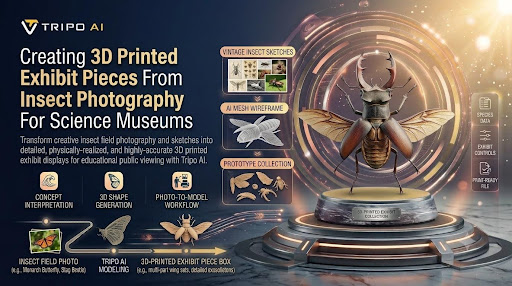
Visit any science centre, and you’ll see exhibits of insects from all over the world. These are amazing examples of biodiversity, adaptation, and evolution. Insects, however, are not easy for visitors to fully enjoy due to their small size, but they are important. The details of wing structure, body segmentation, antennae, and other special features may be difficult to observe behind display cases or in preserved specimens.
That’s where image to 3D technology brings new opportunities to museum exhibits. The project can have a positive impact on insect photography museums by enabling them to produce enlarged, interactive exhibit models that highlight the complexity and beauty of insects. Tripo 3D allows science museums to transform photos into 3D assets and life-size, hands-on exhibit models, making entomology more fun, accessible, and memorable for all ages.
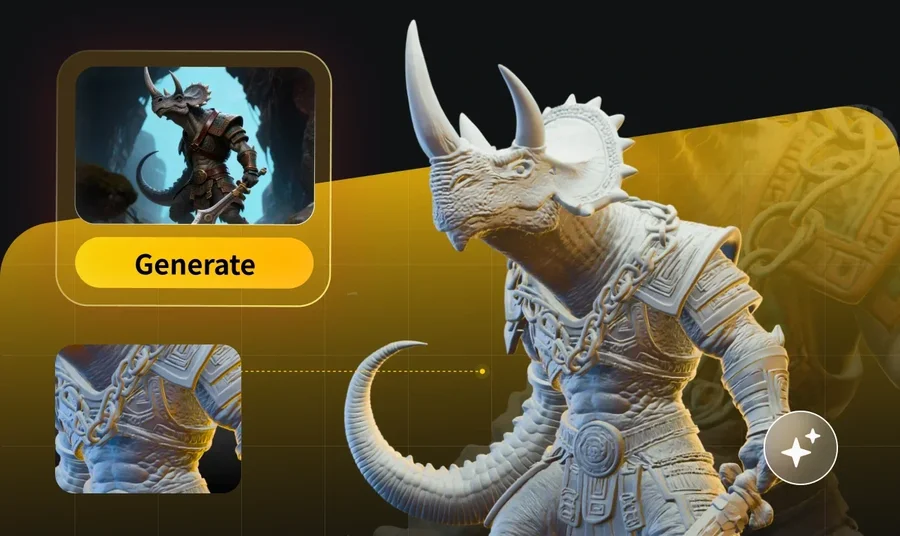
When small critters turn into big-time experiences
Insects are one of the most diverse organisms on earth, but are small in size and may need to be displayed at a smaller size. Consider a giant-sized butterfly model from which one can view all the scales on its wings, or a magnified beetle that displays the body structure and defensive mechanisms. These experiences make visitors see things that they might not see.
Museums can turn “simple” photographs of insects into educational exhibits using Tripo 3D and make microscopic wonders into a captivating visual experience.
The benefits of large insects for learning.
Enlarged models draw far more attention than you’d expect. They convey biological information in a manner that a conventional display can rarely. They assist the visitor in understanding biological concepts in a way that a traditional display cannot.
Revealing hidden details
There are many characteristics of insects that are not easily noticed by the naked eye. Large-scale models can simplify and help understand and examine complex structures.
Encouraging interactive learning
When seeing giant versions of familiar animals, visitors will inevitably have questions. This curiosity can be an impetus to learning more about science.
Bringing science to the people regardless of age
Displays that make scientific concepts more visually and approachable for children, students, and adults.
Transforming insect photos into teaching exhibits.
Lots of insect photography collections are available in museums. The images are from research, pictures, field studies, or a museum archive.
These photographs should not be used for reference only, but can be the basis of dynamic educational displays that are used. Tripo 3D allows museums to transform insect images into detailed 3D models to help educate visitors, enhance museum exhibits, facilitate research presentations, and make public outreach more effective. The outcomes are more engaging approaches to sharing scientific information.
Across the board, from macro to museum-worthy models using Tripo 3D!
It no longer takes expert 3D modeling skills to develop exhibit-quality insect models. Tripo 3D (Tripos) streamlines the process and makes it accessible to museum teams and exhibit designers.
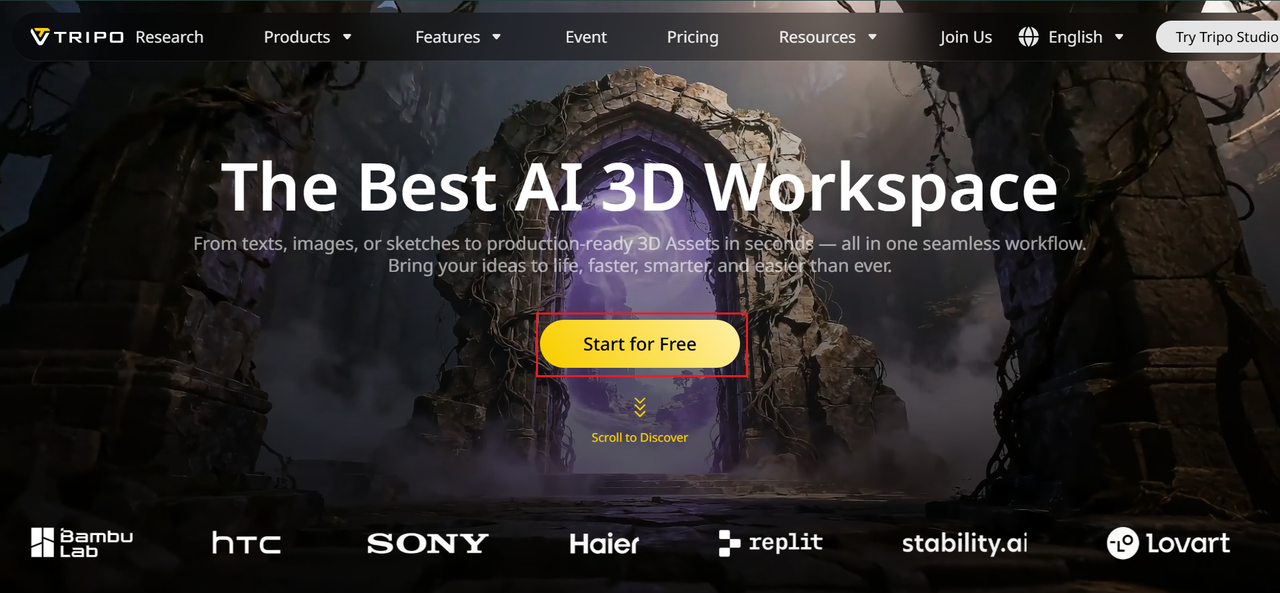
Step 1: Go to Tripo 3D
Start by going to the Tripo AI workspace and choosing your preferred creation method. You can select one of three methods for building a 3D model: Image to 3D, Text to 3D, or Multi-view Images.
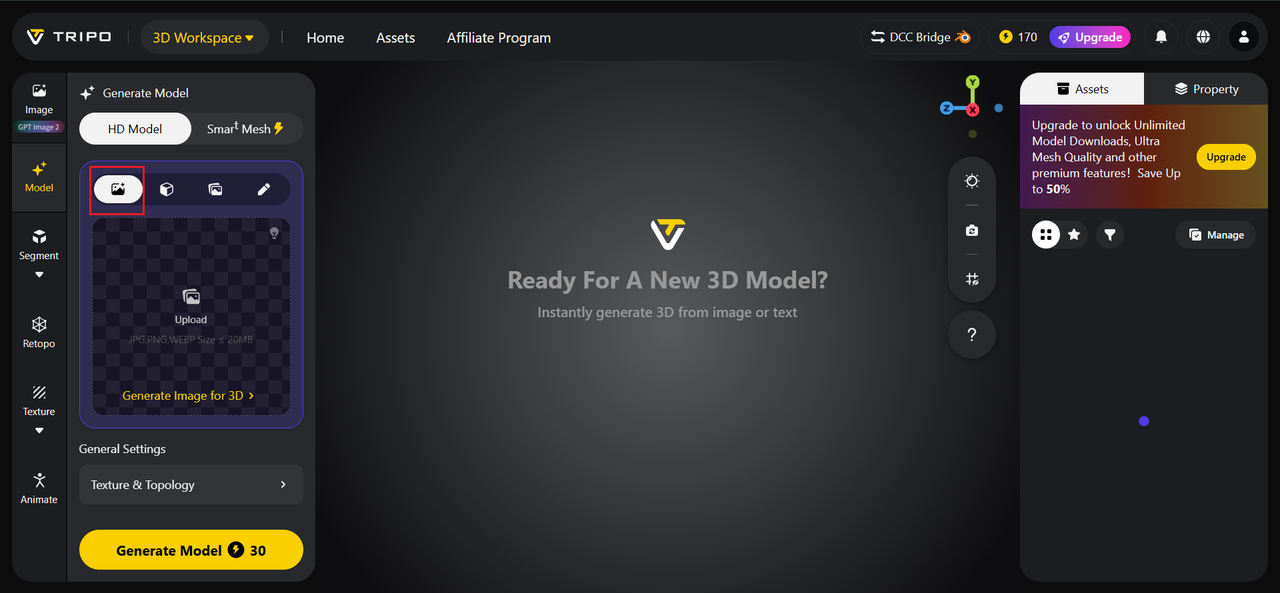
Step 2: Select image and configure settings
Start by uploading an insect image file in .JPG, .PNG, or .WEBp format. Next, you will choose between Ultra and Smart Mesh for mesh quality and will be able to set texture size. To ensure that the biological characteristics and surface patterns of the insect are preserved after creation, a high level of detail is required.
Step 3: Generate and refine
Now click on the Create button, and Tripo AI will create a base model of the selected insect in seconds. You can then refine your materials using Tripo’s material tools, photograph and extract your materials, use Magic Brush to add targeted modifications with increased visual accuracy.
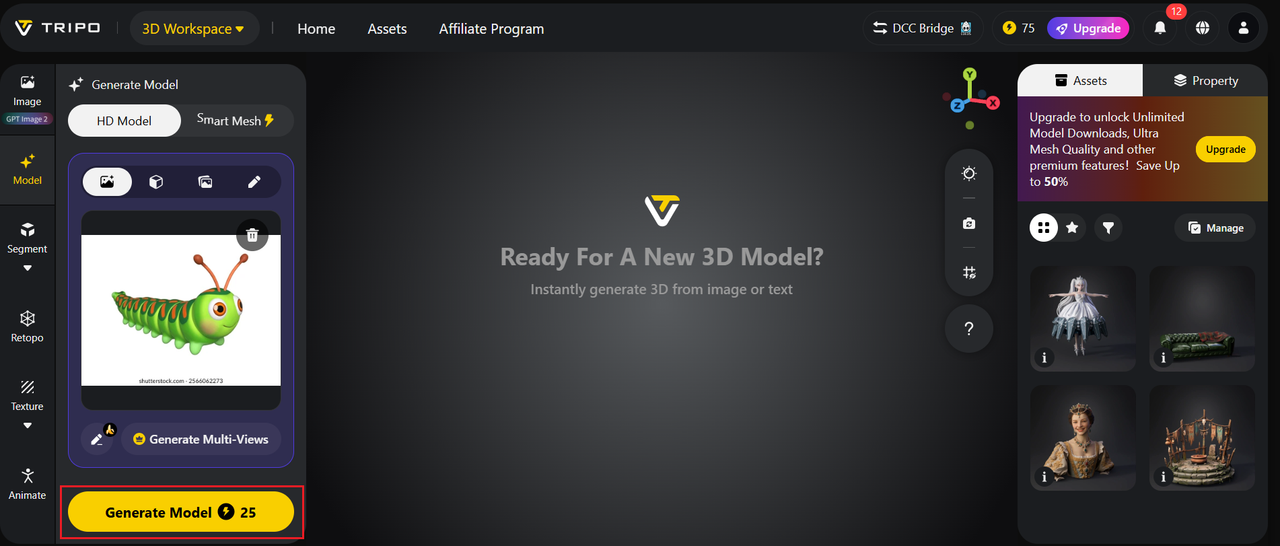
Step 4: Export
Once the model meets your satisfaction, you can export it using the appropriate format for your workflow. Tripo is compatible with STL, OBJ, FBX, GLB, and USD file formats, making it easy to use in exhibit design software, 3D visualization tools, education software, or 3D printing.
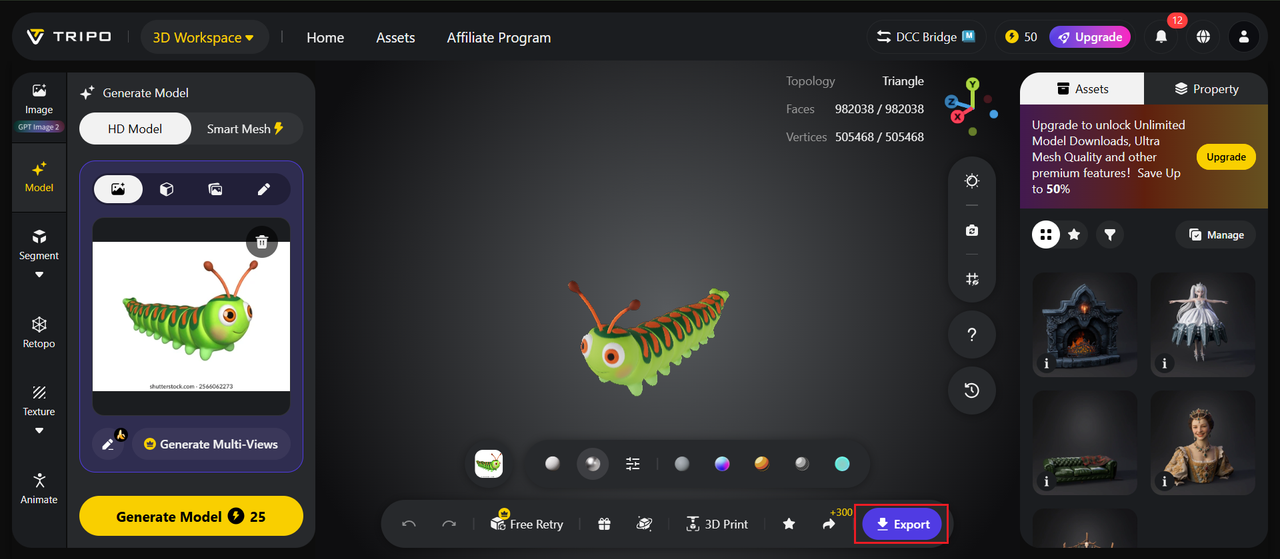
Staging Biodiversity cannot be ignored
Exhibits in the museum must stimulate curiosity. Enlarged bugs are definitely attention grabbers because they show visitors a side of nature that they don’t see often.
The insects can be scaled up to draw attention to issues like pollination, camouflage, adaptation, life cycles, and ecological relationships in museums. It makes visitors sensitive towards organisms that are vital to the ecosystems but are not very visible in the affairs. 3D Modeling Web enables museums to produce these learning resources at a faster rate than traditional modeling processes—and leave more time for exhibiting teams to tell stories and engage visitors.
In addition to display cases, new exhibit opportunities
But the opportunities don’t end with a static display when an insect is turned into a digital model. Models can be used in museums in interactive kiosks, digital learning platforms, augmented reality experiences, educational workshops, and traveling exhibits. The assets can also be used to better disseminate the results of the research to the public.
Tripo 3D allows for the development of a single 3D asset for multiple learning and outreach goals.
This is a digital specimen-to-physical exhibit centerpiece
Physical models have benefits that photos and screens just do not have. Visitors may view structures from a variety of angles and will learn about insect anatomy in detail and scale.
Large-scale reproductions are especially useful in highlighting species that might seem uninteresting because they’re too small. They can be focal points in exhibits to make people stop, look, and learn. A large number of museums are using an image to STL process to create models for 3D printers of insects. This allows them to create strong, lasting exhibits that accurately depict the biological structure while also offering a greater learning experience.
Encouraging curiosity with a bold approach to science
Science museums are important contributors to people’s relationship with nature. The more interactive and understandable it’s made, the more educational it will be.
Using Tripo 3D, museums can convert insect photos into a 3D printed exhibit piece and a detailed digital model, which is accessible to all. Butterflies and beetles, dragonflies and ants – every species can be a chance to spark curiosity, foster exploration and enrich scientific understanding.
Looking to make impactful insect exhibits? Give Tripo 3D a try and see how simple it is to transform insects into detailed 3D models and museum-worthy pieces of exhibit art that will delight visitors and make science come to life.